+1
951 344 5221
 +44
20 8434 3923


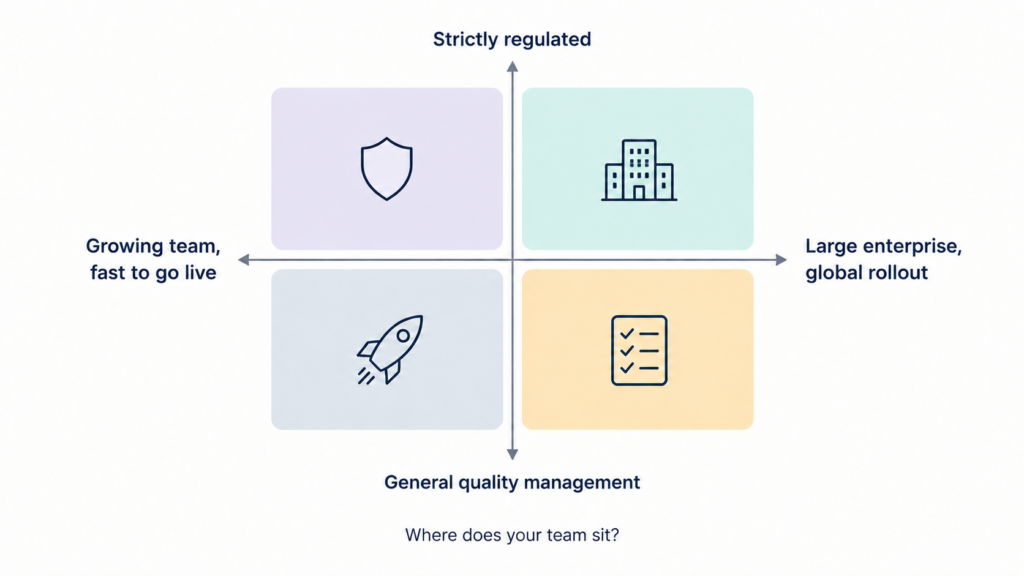
Every quality team shopping for an eQMS is really answering two questions first. Is this for a large enterprise, or for a growing team that needs to be up and running quickly? And is it for a strictly regulated environment, or for general quality management? Platforms are built with different answers to both, which is why two systems with nearly identical feature lists can feel completely different to use. Document control, training, audits, corrective actions, and supplier management appear on almost every list.
The difference is rarely in the list. It is in the origin. Every eQMS was built first around a particular process and a particular kind of buyer, and that starting point still shapes how the platform works, how its modules connect, and where it asks the most of its users.
Why Origins Shape the Product
A platform that began as a document control tool will naturally be strong at revision control, approvals, and evidence. One that began as a way to track nonconformances and investigations will be strong at root cause and follow-through. Later modules are built on that foundation, and the foundation leaves its mark.
None of this makes one approach better than another. Mature platforms have all grown well beyond where they started. The useful question for a buyer is how much of the original shape remains, and whether it matches the way your own team works.
Four Common Starting Points
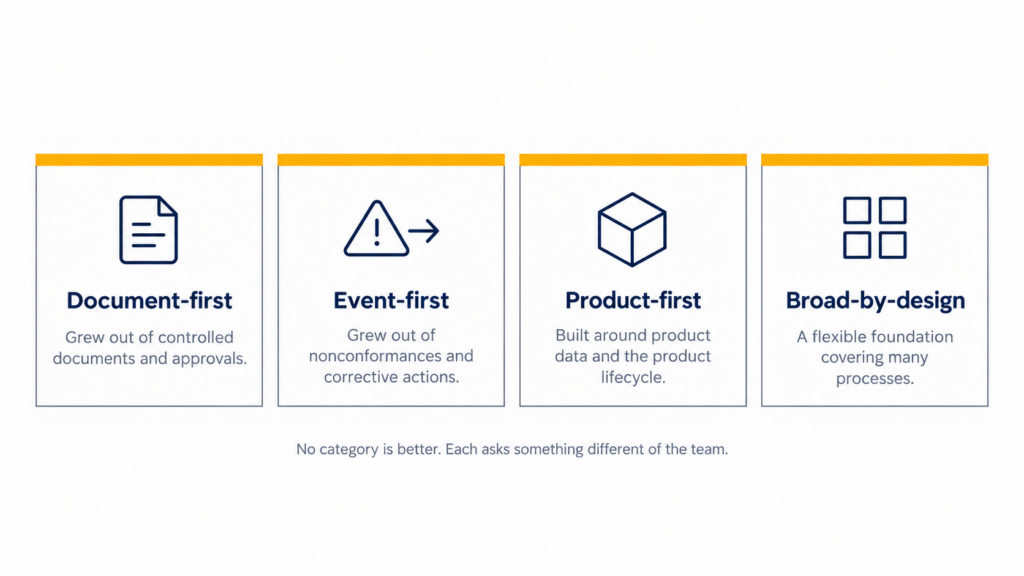
Document-first platforms. These grew out of controlled documents and approvals. Revision control and audit evidence tend to be their strongest ground, while other processes may feel like extensions of the document engine.
Event-first platforms. These grew out of handling complaints, nonconformances, and corrective actions. Investigations and follow-through tend to be their strength, while areas such as documents or training may have arrived later.
Product-first platforms. These are built around product data and the product lifecycle. They suit organizations where quality is closely tied to engineering, and they can feel less natural for work that lives mostly in operations, suppliers, and audits.
Broad-by-design platforms. These start from a flexible foundation meant to cover many processes at once. Their advantage is breadth and a consistent experience across modules. The trade-off is deciding how much to adapt, and avoiding the temptation to rebuild everything before the system has proven itself.
No category is better than another. Each one simply asks a different thing of the team adopting it.
Questions to Ask Any Vendor
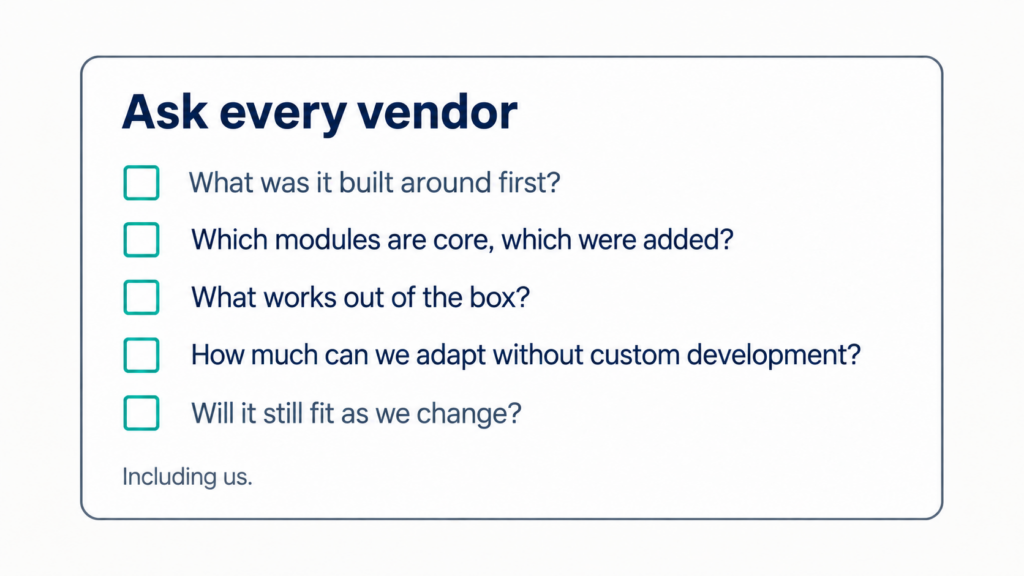
Instead of starting with a feature comparison, a few questions tend to be more revealing, and they are worth asking of every vendor on your list, including us:
- Which process was this platform built around first, and how central is that process to our work?
- Which modules are core to the product, and which were added later?
- How much works out of the box, and how much has to be built before it is useful?
- How much can we adapt without custom development or heavy vendor involvement?
- Will it still fit as our processes change?
The answers say more about long-term fit than a polished demo does, because a demo is built around a vendor’s strongest use case by design.
Ready to Use, Flexible When It Matters
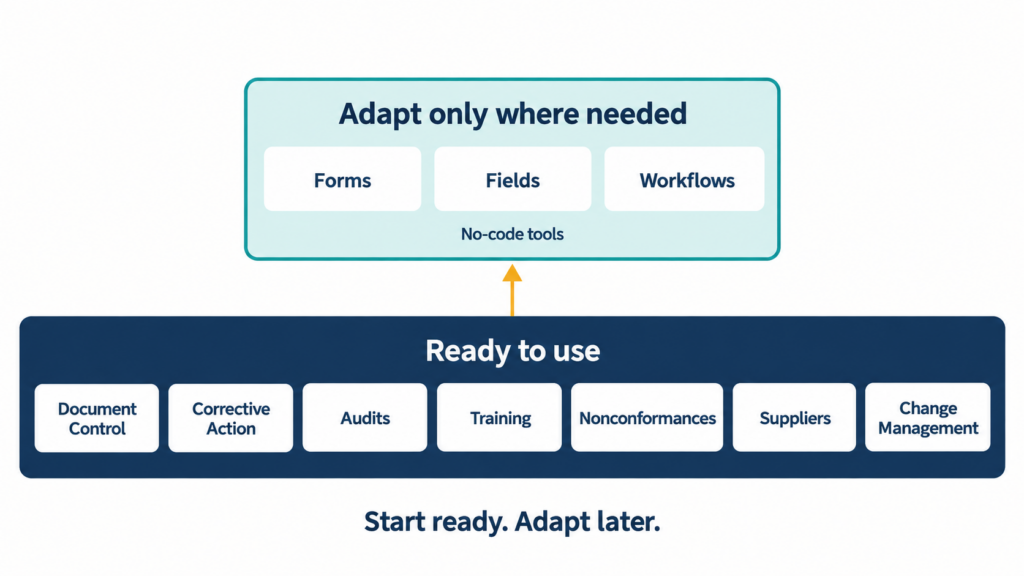
Trackmedium eQMS is built to work well straight out of the box and to flex around how a business actually works, without forcing it into a rigid way of working. Ready-to-use modules for document control, corrective action management, audits, training, nonconformances, suppliers, and change management work as one connected system, and the same platform extends into safety processes such as job safety analysis, safety data sheets and emergency response.
When a process needs to differ, no-code tools let teams adapt forms, fields, and workflows without an IT team or custom development. Real-time dashboards and reporting draw on the same connected records.
Our recommendation is simple: start with the ready-to-use modules wherever they fit, and adapt later only where your business genuinely needs it. That keeps the launch fast, the system easy to maintain, and the flexibility available for when it matters.
The same platform serves teams under strict regulatory requirements, with built-in support for standards such as ISO 9001, ISO 13485, and FDA 21 CFR Part 11, and teams that simply want a clear, organized way to run quality, and it grows with the organization.
No eQMS is the right choice in every situation. The most useful evaluation starts by recognizing what each platform was built to do, and then asking how closely that matches what you need it to do tomorrow.
If you are comparing eQMS platforms, request a Trackmedium eQMS demo to see how a ready-to-use, flexible system fits your own processes.
All images in this post, including the header image, were AI-generated.